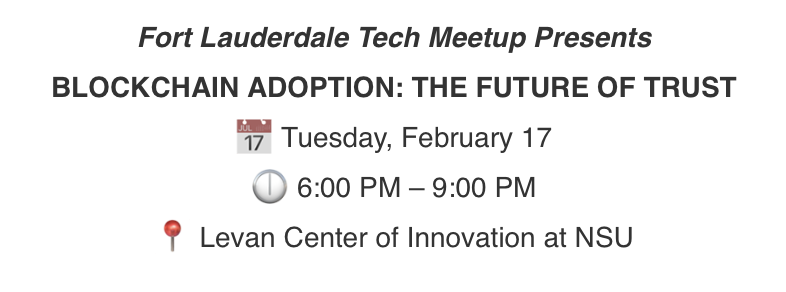
Discussion on Blockchain and AI Security 6:00 PM 2026/02/17 Fort Lauderdale, US Generated by AI. Please verify before use. Conversation Summary The conversation covers the Louisiana Center’s role in fostering entrepreneurship, various financial and cybersecurity services for startups and blockchain, and Halborn’s growth and contributions to Web3 security. Louisiana Center fosters entrepreneurship and innovation Louisiana Center: Michael Bertha, the executive director of the Louisiana Center of Innovation, describes it as a “playground for entrepreneurs.” Center Offerings: The Louisiana Center offers a coworking community, advanced research facilities, and tools like quantum computing and volumetric capture equipment. Public-Private Partnership: The Louisiana Center is a public-private partnership between Broward County and Nova Southeastern University. Community Focus: The center is open to the public and caters to the community. Podcast Recordings: The Fort Lauderdale Tech Meetup records live podcast recordings at the Louisiana Center every month. EisnerAmper offers fractional CFO services to startups EisnerAmper Services: Isaac Amber sponsors the event, offering services like bookkeeping, taxes, and CFO services. CFO Services Contact: Fritz Spencer is the contact person for EisnerAmper’s CFO services. Fractional CFO Role: Fritz Spencer provides fractional CFO services and back-office support for startups from seed to Series A. Halborn specializes in Web3 cybersecurity and compliance Halborn’s CTO: Stephen Wahlbro is the CTO and co-founder of Halborn, a cybersecurity firm. Halborn’s Specialization: Halborn specializes in Web3 security.
Halborn’s Evolution: Halborn initially focused on traditional Web2 security before converging with Web3. Halborn’s Goal: Halborn aims to enable secure transactions and technology adoption for enterprises in Web3. Halborn’s Advisory Role: Halborn assists institutions by conducting risk assessments on technology and implementation. Trust and real-world use cases drive blockchain adoption Trust in Tech Adoption: Trust is crucial for the adoption of new technologies like blockchain and Web3, especially after past speculative activities. Real-World Use Cases: Real-world use cases and regulatory clarity are key factors driving enterprise investment and adoption of blockchain. Barriers to Adoption: Technological, personal (trust/speculation), and administrative (regulatory) barriers hinder blockchain and Web3 adoption. Banks and Blockchain: Even risk-averse institutions like banks are interested in blockchain for tokenization, stablecoins, and real-world assets. Mitigating Risk: Companies like Halborn help banks by conducting risk assessments to ensure secure and correct implementation of blockchain. Banks interest in blockchain for custody and compliance Bank Interest: Large financial institutions like UBS, Citibank, and BNY Mellon are interested in blockchain and Web3 technologies. Blockchain Custody: Banks are particularly interested in the challenges surrounding custody in the blockchain space. Compliance Integration: Banks aim to integrate traditional processes like KYC and transaction risk assessment into blockchain operations. Risk Assessment: Halborn assists banks by conducting risk assessments on technology and implementation to mitigate risks. Secure Implementation: Halborn emphasizes secure blockchain implementation to protect users and their finances. Halborn discovered critical Dogecoin network vulnerability Halborn Dogecoin Vulnerability: Halborn, while auditing Dogecoin’s open-source code for Binance, discovered a critical vulnerability.
Vulnerability Impact: This vulnerability could cause all nodes on the Dogecoin mainnet to run out of memory and shut down, crippling the network. Cross-Chain Vulnerability: The same vulnerability was also present in Litecoin and approximately 200 other forked chains due to Bitcoin’s accidental patch of a similar issue. Coordinated Patch Effort: Halborn coordinated with core developers of all affected chains to implement a stealth patch, informing miners to update their systems before a public release. Fortune Magazine Coverage: The discovery and handling of this critical Dogecoin vulnerability were featured in Fortune magazine. Halborn mitigates 51% attacks and other blockchain threats Blockchain Threats: Halborn works to prevent, detect, and address specific threats in the blockchain space, including zero-day issues. Dogecoin Vulnerability: Halborn discovered a critical vulnerability in Dogecoin’s open-source code that could shut down the network. 51% Attack Explanation: Stephen Wahlbro explains a 51% attack as an entity controlling over 51% of a proof-of-work network’s hash power. 51% Attack Impact: A 51% attack would likely render the manipulated cryptocurrency worthless due to network shutdown. Halborn’s accidental entrepreneurial growth to 230 employees Entrepreneurial Growth: Halborn grew organically from two co-founders to approximately 230 employees globally. Accidental Entrepreneur: Stephen Wahlbro describes himself as an “accidental entrepreneur” who previously preferred working independently. Co-founder’s Network: His co-founder leveraged a strong network within the blockchain community to secure their first client. First Client Success: Halborn’s first client, VACT (Yosaki Exchange), hired them to audit their custody server, leading to successful “hacking.” Organic Expansion: This initial success led to more clients, prompting the hiring of their first employee and subsequent organic growth. Halborn leverages AI for cybersecurity and code auditing
AI in Cybersecurity: Halborn has expanded its services to include AI security, recognizing the significant external and internal security risks associated with emerging AI technologies. AI for Code Auditing: Halborn is now using AI to audit AI-generated code, a process described as “very interesting times” and akin to AIs “talking shit to each other.” AI Tools Automation: Halborn is automating and productizing many of its cybersecurity services using AI, despite initial doubts about AI’s ability to effectively identify bugs in code. Rapid Development and Risks: The rapid development facilitated by AI introduces new security risks and opportunities for Halborn’s cybersecurity services. AI for Rapid Coding: Halborn has established a development team that leverages AI for rapid coding, achieving in a week what would take a year at a larger company. Halborn’s Access conference focuses on stablecoin risk Halborn Conference Focus: Halborn’s annual “Access” conference, an invite-only event at the New York Stock Exchange, focused on stablecoins and tokenization. Stablecoin Risk Framework: Stephen Wahlbro presented a stablecoin risk framework at the Access conference, which was well-received by major banks. Framework Importance: This framework is crucial for fostering adoption and progress in the DeFi and stablecoin space by providing a standardized approach. Stablecoin Collateralization: Stablecoins are now collateralized, unlike the Federal Reserve’s 0% collateralization for deposits. Algorithmic Stablecoins: Algorithmic stablecoins maintain their value through arbitrage and dynamic supply adjustment. Action Items Follow Halborn for content